
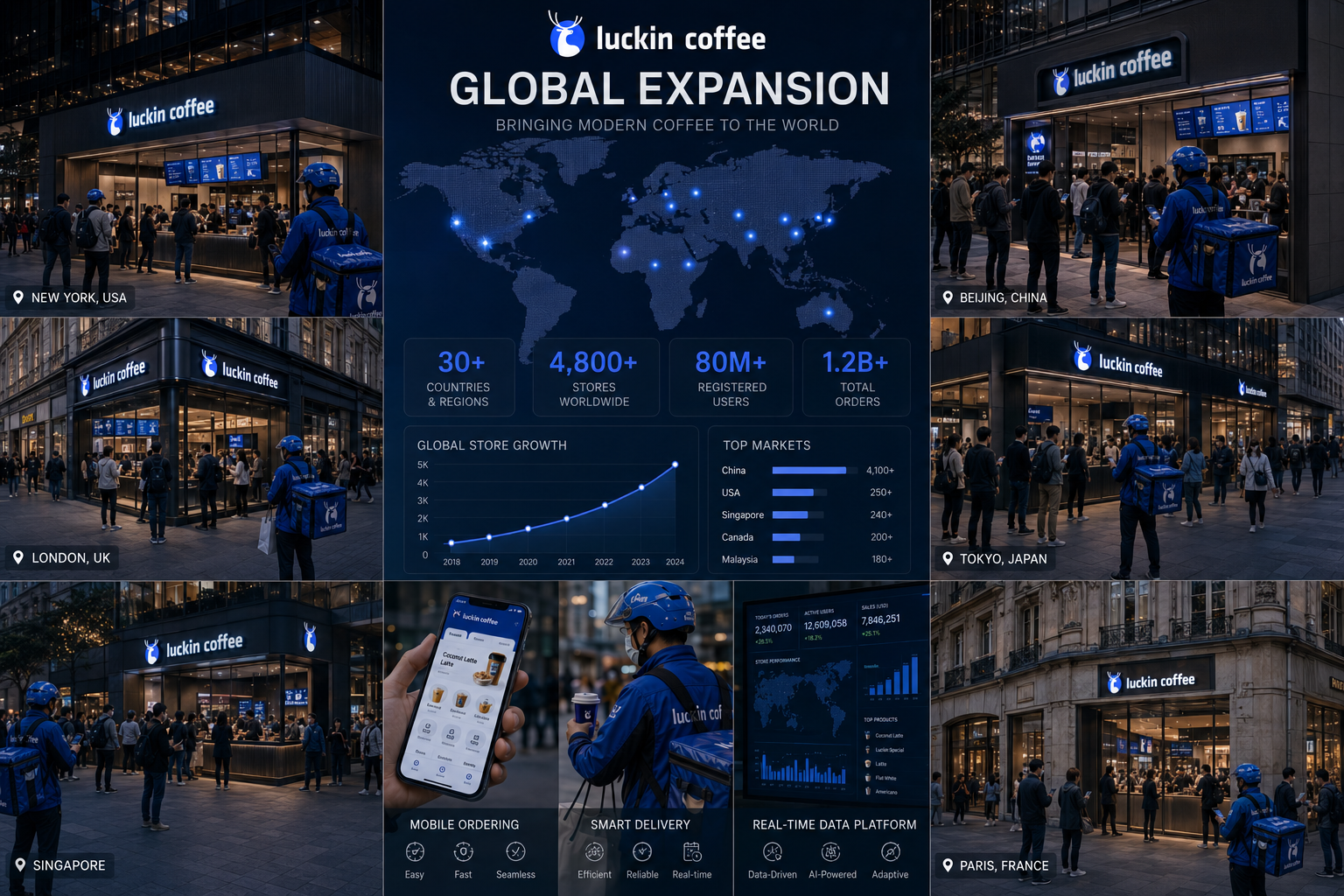
International coffee expansion is no longer driven solely by brand recognition.
The modern coffee industry operates inside a far more complex global environment shaped by:
- urban density
- mobile ordering behavior
- delivery ecosystems
- premium beverage demand
- real estate efficiency
- digital customer acquisition
- operational scalability
For decades, global coffee growth followed a relatively traditional pattern. Brands expanded through flagship cafés, premium shopping districts, and lifestyle-oriented retail environments designed to maximize physical visibility and customer experience.
That model still holds influence.
However, the next generation of coffee expansion is increasingly being shaped by operational systems capable of scaling efficiently across modern urban markets.
Luckin Coffee’s rise reflects this transition.
Its rapid growth demonstrates how digitally integrated retail infrastructure, compact deployment strategies, and app-based customer ecosystems are reshaping how coffee brands approach international market expansion.
Understanding how coffee brands scale internationally now requires understanding the intersection between:
- retail operations
- logistics
- technology
- urban consumer behavior
- commercial real estate strategy
The strongest operators increasingly function as both beverage businesses and scalable retail infrastructure systems.
International Coffee Expansion Has Changed
Traditional international expansion models depended heavily on:
- large-format café deployment
- premium retail visibility
- destination-oriented consumer traffic
- high-investment flagship environments
This approach created globally recognizable coffee brands, but it also introduced:
- higher rollout costs
- slower deployment timelines
- increased real estate dependency
- operational complexity
Modern urban conditions are changing those economics.
Several structural shifts are influencing coffee expansion globally:
- rising commercial rents
- app-based ordering behavior
- commuter-driven consumption
- delivery culture
- mobile payment ecosystems
- convenience-focused purchasing patterns
These trends increasingly favor scalable operational systems rather than purely physical retail presence.
The Importance of Urban Density
Coffee expansion works differently in dense urban environments.
Modern coffee systems thrive in markets where:
- commuter traffic is high
- delivery infrastructure is mature
- smartphone penetration is strong
- consumers prioritize convenience
- premium beverage culture exists
- mixed-use development is expanding
This is why global coffee growth increasingly concentrates around:
- business districts
- transit corridors
- university clusters
- residential high-rise zones
- major commercial ecosystems
Urban density creates high-frequency beverage demand.
Brands capable of serving this demand efficiently gain significant expansion advantages.
Why Mobile Ordering Matters
One of the most important changes inside the coffee sector is the normalization of app-based purchasing behavior.
Consumers increasingly expect:
- mobile ordering
- digital payments
- loyalty integration
- order customization
- fast pickup systems
- delivery accessibility
This shift changes how coffee brands scale internationally.
Historically, expansion depended heavily on physical storefront visibility.
Today, digital visibility increasingly functions alongside physical retail presence.
Brands with strong app ecosystems gain advantages through:
- customer retention
- purchasing data
- promotional targeting
- delivery integration
- frequency optimization
Luckin Coffee’s expansion structure aligns closely with these trends.
Delivery Culture Is Reshaping Expansion Strategy
Delivery infrastructure has fundamentally altered food and beverage retail.
Coffee delivery was once considered operationally difficult because of:
- timing sensitivity
- transportation concerns
- product consistency challenges
Modern logistics ecosystems changed those assumptions.
Consumers now regularly order coffee:
- to offices
- to residential towers
- during meetings
- through mobile platforms
- as part of recurring digital behavior
This creates major opportunities for coffee systems optimized around:
- operational efficiency
- compact deployment
- fast preparation
- delivery coordination
- high transaction frequency
Brands capable of integrating effectively into delivery ecosystems can scale faster across urban markets.
Why Compact Retail Systems Scale Faster
Large-format cafés often require:
- premium locations
- extensive fit-outs
- larger staffing structures
- longer construction timelines
- higher operational costs
Compact coffee systems reduce many of these barriers.
Smaller retail formats allow brands to:
- deploy faster
- lower setup complexity
- improve urban coverage
- optimize delivery radius performance
- scale across multiple districts simultaneously
This creates stronger multi-unit rollout capability.
International expansion increasingly favors operational flexibility over physical scale alone.
Standardization Is Critical to International Growth
The strongest coffee expansion systems rely heavily on operational standardization.
Successful international rollout requires:
- consistent beverage preparation
- repeatable workflows
- scalable staffing structures
- supply chain coordination
- operational efficiency
- digital management systems
Without standardization, rapid international growth becomes difficult to sustain.
Digitally integrated coffee brands often gain advantages because operational systems can be replicated efficiently across multiple markets.
Why Data Is Becoming a Competitive Advantage
Modern coffee expansion increasingly depends on customer intelligence.
Technology-enabled systems can analyze:
- purchase frequency
- regional consumption patterns
- peak demand periods
- customer preferences
- delivery performance
- retention behavior
This data improves:
- territory planning
- operational forecasting
- marketing efficiency
- inventory coordination
- expansion decisions
Traditional retail systems often operate with less visibility into customer behavior.
Digital coffee brands increasingly treat data infrastructure as a core expansion asset.
The Role of Multi-Unit Operators
International coffee growth increasingly depends on strong multi-unit expansion capability.
Successful operators often understand:
- urban market structure
- commercial real estate
- workforce systems
- logistics coordination
- delivery integration
- operational scalability
The ability to deploy multiple locations efficiently across dense urban territories has become increasingly important.
District-level clustering strategies often outperform isolated flagship deployment because they improve:
- brand visibility
- delivery efficiency
- customer accessibility
- operational coordination
This is particularly important inside major commuter cities.
Best Markets for International Coffee Expansion
Several global regions continue creating strong conditions for modern coffee growth.
Middle East
The Middle East remains one of the most attractive premium beverage growth markets globally.
Key drivers include:
- luxury mall development
- younger demographics
- strong café culture
- premium consumer spending
- delivery infrastructure maturity
- high smartphone penetration
Key expansion cities include:
- Dubai
- Riyadh
- Doha
- Abu Dhabi
- Jeddah
These markets support both premium café systems and digitally integrated convenience models.
Southeast Asia
Southeast Asia continues experiencing rapid coffee sector growth driven by:
- urban population density
- app-based purchasing behavior
- delivery adoption
- commuter consumption patterns
- expanding middle-class demand
Major growth cities include:
- Jakarta
- Bangkok
- Manila
- Singapore
- Kuala Lumpur
- Ho Chi Minh City
The region aligns strongly with digitally integrated coffee systems.
Europe
Several European markets are increasingly shifting toward:
- fast pickup systems
- commuter-driven purchasing
- compact coffee deployment
- delivery-enabled retail behavior
This creates strong opportunities for scalable urban coffee expansion.
Why Investors Continue Watching Coffee Expansion
Coffee remains one of the strongest recurring consumer categories globally.
Investors continue monitoring the sector because it combines:
- daily transaction frequency
- premium pricing capability
- scalable operations
- urban growth compatibility
- digital integration
- delivery ecosystem alignment
The strongest coffee systems increasingly resemble retail-tech infrastructure capable of scaling efficiently across multiple international markets.
The Future of Global Coffee Scaling
The future of coffee expansion will likely prioritize:
- operational flexibility
- digital infrastructure
- customer data ecosystems
- compact deployment
- delivery integration
- commuter convenience
- scalable urban penetration
Traditional flagship cafés will likely remain important for premium brand positioning.
However, digitally optimized systems may increasingly dominate high-frequency urban consumption environments.
Coffee expansion is evolving into multiple operating architectures designed for different consumer behaviors.
Strategic Conclusion
Scaling coffee brands internationally now requires far more than premium branding or physical storefront visibility.
The strongest systems increasingly combine:
- technology integration
- operational standardization
- urban deployment efficiency
- customer data infrastructure
- delivery compatibility
- mobile ordering ecosystems
Luckin Coffee’s expansion reflects how rapidly the global coffee sector is adapting to digitally integrated consumer behavior.
As urban populations continue prioritizing convenience, speed, and mobile engagement, coffee brands capable of scaling operationally across dense global markets may continue gaining structural expansion advantages.
For operators, investors, developers, and market-entry groups, the long-term opportunity lies in understanding how retail infrastructure, technology systems, and consumer convenience are converging inside the next generation of coffee expansion.
Explore Strategic Luckin Coffee Franchise and Market-Entry Opportunities
Explore strategic Luckin Coffee franchise and market-entry opportunities:
Leave a Reply