
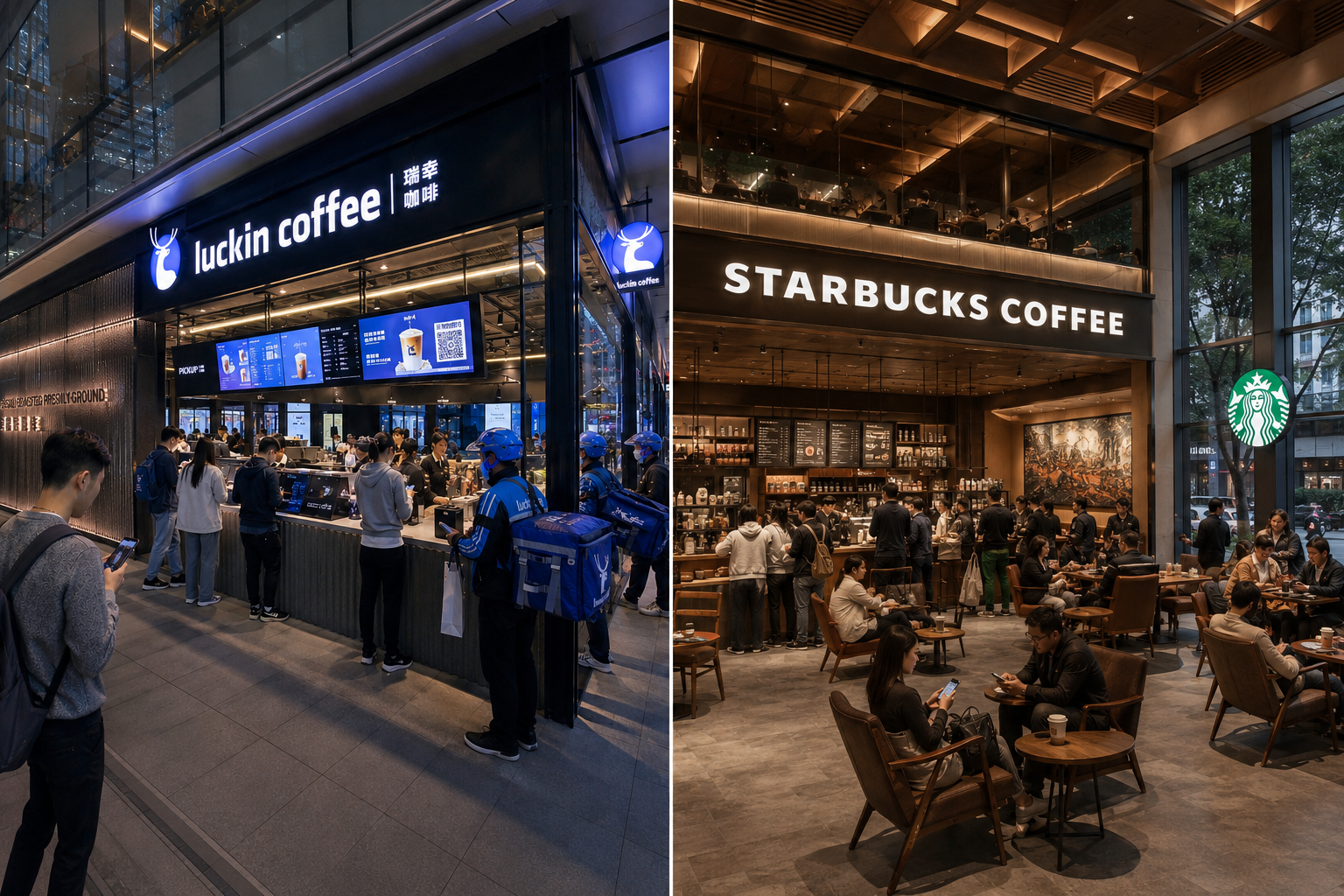
The global coffee industry is no longer expanding through a single operating model.
For decades, Starbucks defined the international coffee growth playbook through premium café environments, strong lifestyle branding, large-format stores, and destination-based customer experiences. That model shaped modern coffee culture across multiple continents and established Starbucks as one of the most influential consumer brands in retail history.
A different expansion architecture is now emerging.
Luckin Coffee represents a newer generation of digitally integrated coffee retail built around:
- app-based ordering
- compact-format deployment
- delivery ecosystem integration
- high-frequency commuter transactions
- operational scalability
- urban convenience positioning
The comparison between Luckin Coffee and Starbucks is not simply about coffee quality or branding.
It reflects two fundamentally different approaches to how modern retail systems scale internationally.
One model was built primarily around physical experience.
The other was built around digital operational efficiency.
Both can succeed. However, changing urban behavior, mobile-first consumption patterns, and delivery-driven retail ecosystems are creating conditions that increasingly favor technology-enabled expansion structures.
The Starbucks Expansion Model
Starbucks transformed global coffee consumption by positioning coffee retail as a lifestyle experience rather than merely a beverage transaction.
Its expansion strategy historically focused on:
- premium café environments
- in-store customer experience
- longer customer dwell time
- brand atmosphere
- seating-oriented layouts
- destination retail positioning
This model created several advantages:
- strong emotional brand identity
- premium consumer perception
- global brand recognition
- customer loyalty
- real estate visibility
Starbucks became deeply associated with modern urban culture.
In many markets, Starbucks stores functioned not only as coffee outlets but also as:
- meeting spaces
- work environments
- social destinations
- commuter breakpoints
That positioning helped the company establish enormous international scale.
The Operational Weight of Traditional Café Expansion
The traditional café model also introduced structural complexity.
Large-format coffee stores typically require:
- premium real estate
- extensive fit-outs
- high staffing levels
- significant operational overhead
- longer development timelines
- higher capital deployment
These requirements can slow rollout velocity, particularly in:
- high-rent cities
- emerging markets
- dense urban corridors
- rapidly scaling territories
As retail behavior evolved toward convenience-driven consumption, these operational pressures became more visible.
This created space for alternative coffee expansion systems.
The Luckin Coffee Expansion Structure
Luckin Coffee’s operational architecture reflects a very different retail philosophy.
Instead of prioritizing large café environments, the model emphasizes:
- speed
- digital ordering
- delivery integration
- compact retail formats
- urban scalability
- operational efficiency
Its ecosystem was designed around mobile consumption behavior from the beginning.
This distinction matters.
Many traditional chains integrated mobile ordering into already existing retail systems. Luckin Coffee structured the business around app-based purchasing itself.
That creates structural advantages in:
- customer acquisition
- order efficiency
- delivery optimization
- rollout scalability
- commuter accessibility
- urban density penetration
App-Based Ordering Is Changing Coffee Retail
The rise of mobile ordering is fundamentally reshaping how beverage brands compete.
Consumers increasingly prioritize:
- convenience
- transaction speed
- digital payments
- order customization
- delivery access
- pickup efficiency
This shift is especially visible among:
- younger demographics
- office professionals
- urban commuters
- students
- mobile-first consumers
In many cities, digital visibility now carries similar importance to physical storefront visibility.
Brands with strong app ecosystems gain advantages through:
- loyalty retention
- promotional targeting
- customer data
- purchasing frequency analysis
- delivery integration
Luckin Coffee’s structure aligns directly with this transition.
Compact Coffee Formats vs Large Café Environments
One of the biggest differences between the two expansion models lies in real estate strategy.
Starbucks historically prioritized:
- prominent storefronts
- larger layouts
- seating capacity
- experiential environments
Luckin Coffee prioritizes:
- compact deployment
- pickup efficiency
- delivery compatibility
- smaller operational footprints
- high-density urban placement
Compact formats create several expansion advantages:
- faster rollout
- lower setup costs
- increased deployment flexibility
- easier multi-unit scaling
- improved delivery radius optimization
This becomes increasingly important in dense cities where commercial real estate costs continue rising.
Delivery Culture Is Favoring New Retail Structures
Delivery infrastructure has significantly altered consumer behavior across food and beverage retail.
Coffee delivery was once viewed as secondary purchasing behavior.
Today, delivery ecosystems are deeply integrated into daily urban routines.
Consumers increasingly order coffee:
- to offices
- to residential buildings
- during commutes
- through app ecosystems
- via subscription-style behavior
This benefits brands optimized for:
- fast preparation
- operational efficiency
- compact deployment
- delivery logistics
- high transaction frequency
Large seating-focused café systems often carry heavier operational overhead relative to delivery efficiency.
Digitally integrated compact models align more naturally with delivery-driven urban consumption.
Different Expansion Speeds
Luckin Coffee’s operational structure allows for faster deployment in many urban markets.
Several structural factors contribute to this:
- smaller retail footprints
- lower real estate dependency
- standardized operational systems
- reduced fit-out complexity
- digital customer acquisition
- streamlined staffing structures
This allows operators to approach expansion through:
- district-level clustering
- multi-unit deployment
- delivery-zone optimization
- rapid territory penetration
Traditional café models often expand more slowly because each location requires larger operational investment.
Why Investors Are Watching Both Models
Despite the differences, both Starbucks and Luckin Coffee remain highly influential within the global coffee sector.
Starbucks continues benefiting from:
- premium global brand equity
- strong lifestyle positioning
- customer loyalty
- extensive international infrastructure
Luckin Coffee benefits from:
- operational flexibility
- digital scalability
- app integration
- faster rollout capability
- delivery compatibility
Investors increasingly recognize that the future coffee industry may support multiple operating structures simultaneously.
However, digitally integrated systems are attracting growing attention because they align closely with changing urban retail behavior.
Which Model Fits the Future of Urban Retail?
The answer may depend on how cities continue evolving.
Several macro trends support digitally integrated expansion:
- rising commercial rents
- increasing delivery adoption
- commuter-driven consumption
- smartphone dependency
- app-based purchasing behavior
- convenience prioritization
At the same time, premium café experiences will likely remain important in:
- flagship retail districts
- luxury environments
- tourism-heavy markets
- destination lifestyle zones
This suggests that the future coffee landscape may become increasingly segmented between:
- experience-focused café systems
- digitally optimized convenience systems
Luckin Coffee and Starbucks represent two different ends of that spectrum.
Global Markets Driving Coffee Expansion
Several international regions continue creating strong conditions for both traditional and digitally integrated coffee systems.
Middle East
The Middle East remains one of the strongest premium beverage growth markets globally.
Expansion drivers include:
- luxury mall ecosystems
- high disposable income
- strong café culture
- younger populations
- smartphone penetration
- delivery ecosystem maturity
Key cities include:
- Dubai
- Riyadh
- Doha
- Abu Dhabi
- Kuwait City
Southeast Asia
Southeast Asia continues showing rapid growth in:
- app-based consumption
- delivery adoption
- urban coffee demand
- premium beverage culture
Key markets include:
- Bangkok
- Jakarta
- Manila
- Kuala Lumpur
- Singapore
- Ho Chi Minh City
These markets align strongly with digitally integrated retail structures.
Europe
Several European cities are increasingly shifting toward:
- commuter-oriented retail
- fast pickup systems
- compact urban formats
- delivery integration
This creates favorable conditions for scalable convenience-based coffee deployment.
Strategic Conclusion
The comparison between Luckin Coffee and Starbucks reflects a broader transformation occurring across global retail.
Starbucks helped define the premium lifestyle café era.
Luckin Coffee reflects the rise of digitally integrated coffee infrastructure built around:
- app ecosystems
- delivery compatibility
- compact deployment
- operational efficiency
- commuter convenience
Both models remain influential.
However, changing urban behavior, delivery culture, and mobile-first consumption patterns are creating stronger expansion opportunities for operational systems capable of scaling efficiently across dense modern cities.
For investors, operators, and market-entry groups, the future of coffee retail may increasingly depend on how effectively brands combine:
- technology
- convenience
- scalability
- premium positioning
- urban deployment flexibility
The global coffee industry is no longer expanding through a single blueprint.
It is evolving into multiple retail architectures designed for different phases of modern consumer behavior.
Explore Strategic Luckin Coffee Franchise and Market-Entry Opportunities
Explore strategic Luckin Coffee franchise and market-entry opportunities:
Leave a Reply